Welcome to the Ribo-INK Journal Club! In this series, we regularly highlight one paper, or a small group of papers on a shared topic, that we believe will interest our community.
For our first post, it seemed fitting to start at the very beginning: the origin of life itself. As the Ribo-INK network takes its first steps in bringing together the RNA community of Lyon and Grenoble, we are delighted to launch this series with a paper that places RNA at the heart of how biology may have begun.
Reference: Gianni E, et al., Holliger P. A small polymerase ribozyme that can synthesize itself and its complementary strand. Science (2026). DOI: 10.1126/science.adt2760
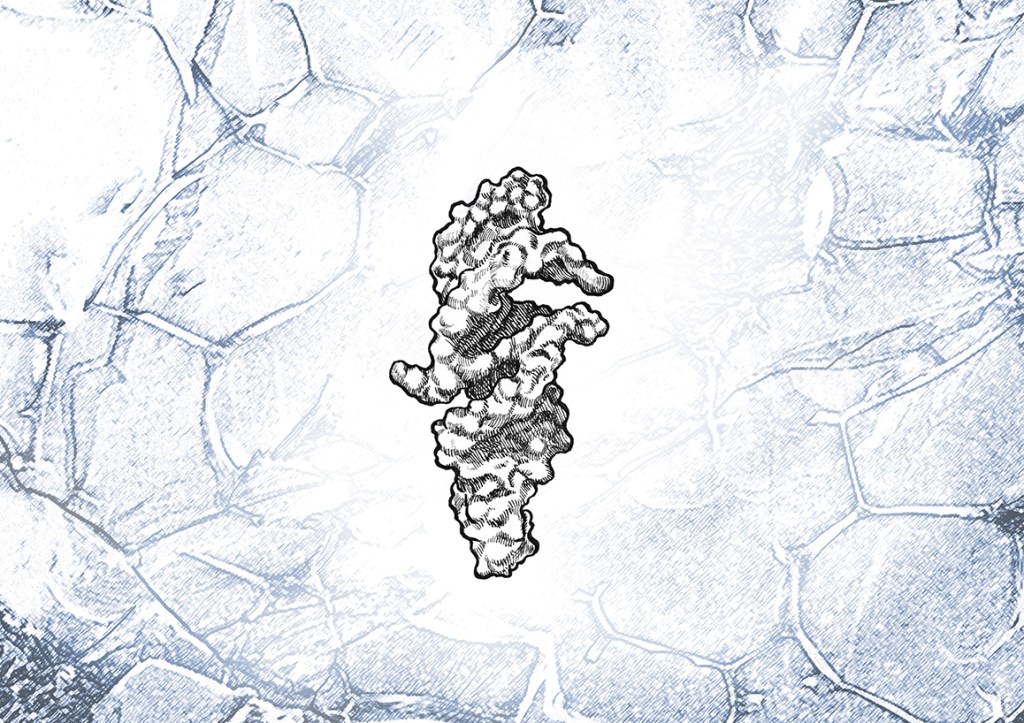
Image: Artist’s depiction of QT45 in a frozen environment. Credit: Elfy Chiang; microscopy image by James Attwater (MRC LMB)
Context
The emergence of a chemical system able to replicate itself and evolve is considered a critical event in the origin of life. According to the RNA world hypothesis, RNA molecules once served both as carriers of genetic information and as catalysts, before DNA and proteins took over these roles.
RNA polymerase ribozymes, which are RNA enzymes that copy RNA, have been developed in the laboratory for decades. However, their large size and structural complexity have prevented them from copying themselves, and make their spontaneous emergence unlikely.
Approach
The team at the MRC Laboratory of Molecular Biology (Cambridge, UK) took a different route. Rather than starting from long molecules, they selected ribozymes from pools of short random RNA sequences.
Over successive rounds, they progressively increased the selective pressure by requiring the templated incorporation of more triplets and by varying the template and primer sequences.
Key findings
- A remarkably small polymerase. QT45 is a 45-nucleotide polymerase ribozyme that catalyses general RNA-templated RNA synthesis. It uses trinucleotide triphosphate (triplet) building blocks in mildly alkaline eutectic ice.
- Broad copying ability. Despite its small size, QT45 can copy a variety of RNA templates, including tightly folded sequences and a sequence encoding an active hammerhead ribozyme.
- Both halves of self-replication. QT45 can synthesise its complementary strand from a random pool of triplets with 94.1% per-nucleotide fidelity. It can also synthesise a copy of itself from defined substrates. Both reactions reach yields of about 0.2% after 72 days.
- A broader implication. Finding polymerase activity in such a small RNA motif suggests that polymerase ribozymes may be more common in RNA sequence space than previously thought.
Is there a paper you would like us to feature in a future Journal Club?


Leave a Reply